


Hello everybody,
This week we’re looking at the beast machine theory of consciousness with Anil Seth.
You can find the companion article here: Can neuroscientists read your mind?
One day, we woke up conscious.
I often think about the first being that suddenly found itself conscious. When did the first Homo sapiens, chimpanzee, horse, crab, or whatever suddenly become aware of the world?
“Oh, wow,” the horse thinks, “these hooves are awesome.”
“Hey mate,” the caveman grunts. “Do you ever kind of just talk to yourself? Like in your head?”
If we assume that consciousness is something that evolves and emerges over millennia, and if we assume that there is an absolute threshold for “ego awareness,” then it seems plausible that something, somewhere had the first conscious thought. Of course, those are two hefty assumptions:
First, we don’t know what consciousness is. Is it wakefulness? Is it awareness of the world? Is it a mental workspace that allows us to imagine, plan, and talk to ourselves? Is it having an ego and subjective experience?
Second, we don’t know where consciousness comes from. It might emerge like the rising sun, or it might pop into existence like a light switch. It might have evolved with our bodies and brains, but it might also be the gift of some panpsychic entity or god.
But, even given those open questions, I think it’s pretty reasonable to ask when something first became “conscious” as we define it. It’s fun to imagine Uruk the Neanderthal as being the first carbon-based life-form in history to have a “thought.”
That “carbon-based life-form” bit is interesting, because every known example of consciousness we have involves organic beings. They have cells, tissues, and neurons. They have bodies, blood, and brains. There are no cases of artificial, non-organic minds.
The question we ask this week is: Will that soon change?
The point of a thought
I’ve had a lot of thoughts today.
When I woke up this morning to the dark of a cold November world, I thought, “It surely can’t be time to wake up already.” It was.
When I opened Microsoft Word to type this newsletter, I looked out of the window to think. I watched as the wind blew away a leaf. I paused to adjudicate a race between two raindrops sliding down the windowpane. A late win from Lefty shocked the room.
Our lives are made up of a billion of these thoughts. But what is the point of them? If we zoom out to see things as a god would see them, what is the point of the human mind? From this perspective, we do the same things as all the other animals. We’re born, we form societies, we have sex, we fight, we run about a bit, and then we die. Animals doing animal things.
And yet, we have a conscious mind — and, I assume, an ant does not. The vast majority of life, both today and throughout our evolutionary past, has managed quite capably without the need to watch rain race down a windowpane.
Epiphenomenalism is the philosophical view that consciousness is pointless. Thoughts are pleasant enough, but they are as irrelevant to life as the clock’s chime is to the time.
Epiphenomenalism is not overly popular in either philosophy or psychology — it’s logically self-defeating (to believe in epiphenomenalism implies thoughts have an effect), and it runs contrary to both common sense and neuroscience (thinking about food will make you hungry). So what is the point of consciousness?
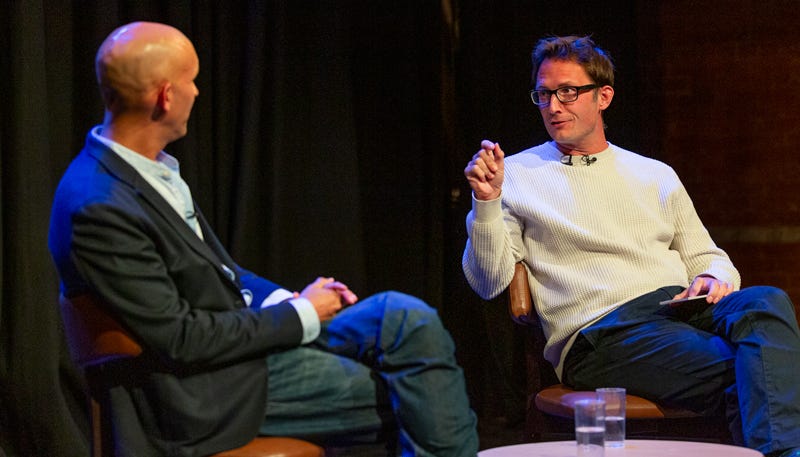
In this week’s Mini Philosophy interview, I spoke with Anil Seth on stage at a Big Think live event in Oxford. You can see the full conversation at the bottom, but over the course of the hour, we talked about Seth’s “beast machine theory.”
Seth argues that consciousness emerges from cellular life because it works to protect that cellular life. Consciousness is a gift that allows us to regulate and care for our bodies and to try and survive just a bit longer than our non-conscious cousins. Consciousness was not plopped into us, but “goes down to the level of the fact that we’re made of cells that regenerate their own components, that transfer energy into matter and back again.”
In other words, we cannot talk about or conceive of consciousness as separate from our bodies. First, our bodies give rise to consciousness — minds emerge from the interplay of neurons, cells, neurochemicals, and so on. But second, consciousness is irrevocably tied to the processes of living.
Of course, the big implication of the beast machine theory is that the notion of artificial intelligence is as impossible as imagining water that isn’t wet. And Seth argues that we need to stop using simplistic, inappropriate, and misleading analogies when it comes to the mind. The mind is not a computer program or a machine. This is how he put it:
We’ve confused the map with the territory. We’ve always used a technological metaphor to understand the brain and it’s always been limited.
We are not programmed to do things. We’re not programmed to have metabolism; we have metabolism. We often talk too loosely about this with our genes as well. Our genes ‘program us to do this or that.’ No, they’re just part of the deeply complex, integrated physiological system that we are.
So, I don’t think it would be enough to have, let’s say, a fancy humanoid robot that you then program its digital brain to go and make sure it plugs itself in or repairs itself if it gets damaged. My suspicion is that the difference between conscious systems and non-conscious systems goes deeper. It goes down to the level of the fact that we’re made of cells.
If Seth is right, then consciousness isn’t something you can bolt onto a clever machine — it’s something that grows out of the messy, metabolic business of staying alive. And that means the mystery of the mind won’t be solved by better code, but by understanding what it really means to be a living creature trying to persist in the world.
IN YOUR OPINION
Lots of great responses to this week’s question about whether we should make a conscious AI (if we could), which resulted in a small back and forth in the comments section. I copied this from John as I think it’s important:
The question which presents itself is: Why shouldn’t it be dangerous? The list is long but not exhaustive and then you have the potential for dangerousness. That’s only the known unknowns.
Technologies carry with them potential harms (possibly all of them do) - I think those who believe in AI or whatever being “benign” are smuggling in their hopes about moral agency on its part. That’s a very long reach. Many of the arguments for a future harmless technology of any kind appear to ignore the inimical consequences of some present day ones.
Next week, we’re exploring passion projects with the birdwatcher and nature photographer Georgia Barker and so I’m asking:
What is your passion?
Send me your thoughts via email or comment below.
MINI READING LIST
The science of effortlessness: How to activate flow | Steven Kotler and Big Think
RESOURCES
This newsletter contains my reflection on the topic at hand. Here is a list of the material shared in this email, as well as extra content about the topic that I've shared on my other social platforms:
The companion article inspired by my conversation with Anil Seth.
My short video examines what is the point of consciousness, featured on Mini Philosophy's YouTube page
The full, unedited video interview with Anil Seth:

Jonny is the creator of the Mini Philosophy social network. He’s an internationally bestselling author of three books and the resident philosopher at Big Think. He's known all over the world for making philosophy accessible, relatable, and fun.
More Big Think content:
Big Think | Big Think Business | Starts With A Bang | Big Think Books
My sense is that consciousness is pervasive & we have various abilities to perceive it. The poem by Rumi ‘When Grapes Turn to Wine’ comes to mind:
When grapes turn to wine,
They long for our ability to change.
When stars wheel around the North Pole,
They are longing for our growing consciousness.
Wine got drunk with us,
Not the other way.
The body developed out of us, not we from it.
We are bees,
And our body is a honeycomb.
We made the body,
Cell by cell we made it.
I loved this and I'm also very confused haha.