


Hello everybody,
This week we’re looking at the quest for truth with John Dewey.
The Quest of Pure Philosophy
“There is a scroll buried deep in the woods,” the sage says, “but to get there is hard.”
You’re sitting in the tavern with all your adventuring friends: Aristo the Archer, Thomas the Cleric, René the Tinker, and Bertrand the Magician. You lean in and listen closely.
“First, you must meet with the Scholarch of the Academy, and he will teach you the Geometric Path. After several years, you will set out to cross the Bridge of Contemplation and abide in thought for a time. Once you are ready, enter the woods. There are creatures within that you must defeat. The LinkedIn Gargoyle will tempt you with a career. The Incubus of Invalid Syllogisms will pretend to be your friend. And finally, hardest of all, the Dragon of Relativity will roar with the voice of a thousand peoples. Overcome all these, and you will find the scroll — the Scroll of Truth. In there, you will find the answer to everything you seek.”
For thousands of years in the Western tradition, this is how philosophers have viewed truth. It’s often called Truth with a capital T — abstracted, perfect, and pure. It’s the single correct answer and the only path, where all others lead to darkness. It’s in Plato’s World of Forms, Aquinas’s Divine Intellect, Descartes’s Meditations, and Russell’s Logical Atomism. It’s in the somewhat short-lived efforts of Leibniz and Frege to create a logical language — beyond and better than our day-to-day languages. The way we talk and live is so messy. So imprecise.
Every mainstream has its counterculture, and so too with Truth. The ancient Skeptics argued that even if there might be some actual answer or reality, we’ll never know it. Millennia later, Nietzsche questioned whether we should want this Scroll of Truth, even were it to exist. But one of the biggest and most coherent alternatives was not found in Europe. It was found in Cambridge, Massachusetts, and at the Metaphysical Club.
This week, we look at pragmatism — the philosophy that says the scroll is actually a map.
Go well,
Jonny
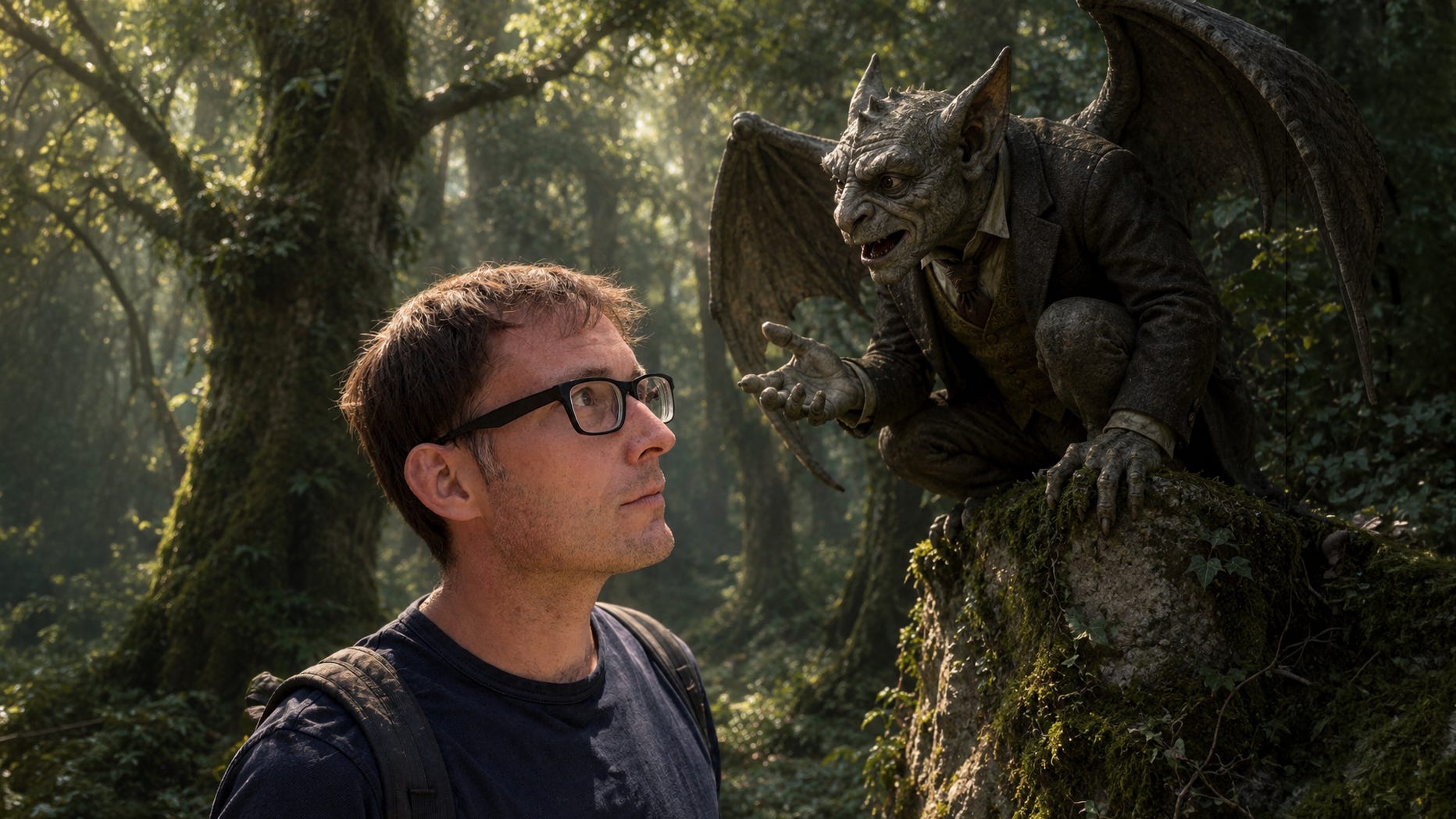
The truth is in the room with us
Pragmatism is an umbrella term for the idea that there is no Truth out there, but rather that truth is whatever works. It’s what allows us to make sense of the world and get things done. The word “discover” has Latin roots, where it meant a kind of revealing. You dis-covered something, like lifting the lid on a box or digging up some buried treasure. And to discover truth in this sense means that we only have to look in the right place — which may or may not be in the deep, dark, high-fantasy woods.
Pragmatism says that truth is not something to discover; truth is something to use.
From there, things get more complicated because the three big names in pragmatism all had different versions to offer.
First, C.S. Peirce was the most absolutist of the lot. He argued that while “truth is what is useful,” humans would eventually — through good reasoning and the scientific method — coalesce on one truth simply because it’s the greatest, best, and most useful.
Then, William James was the most relativistic of the bunch. James argued that we should weigh the merits of any belief by its “cash value” — how does this affect my life? Is this a worldview that makes me happier and better, and lets me live more easily? Believe and do whatever makes your life work.
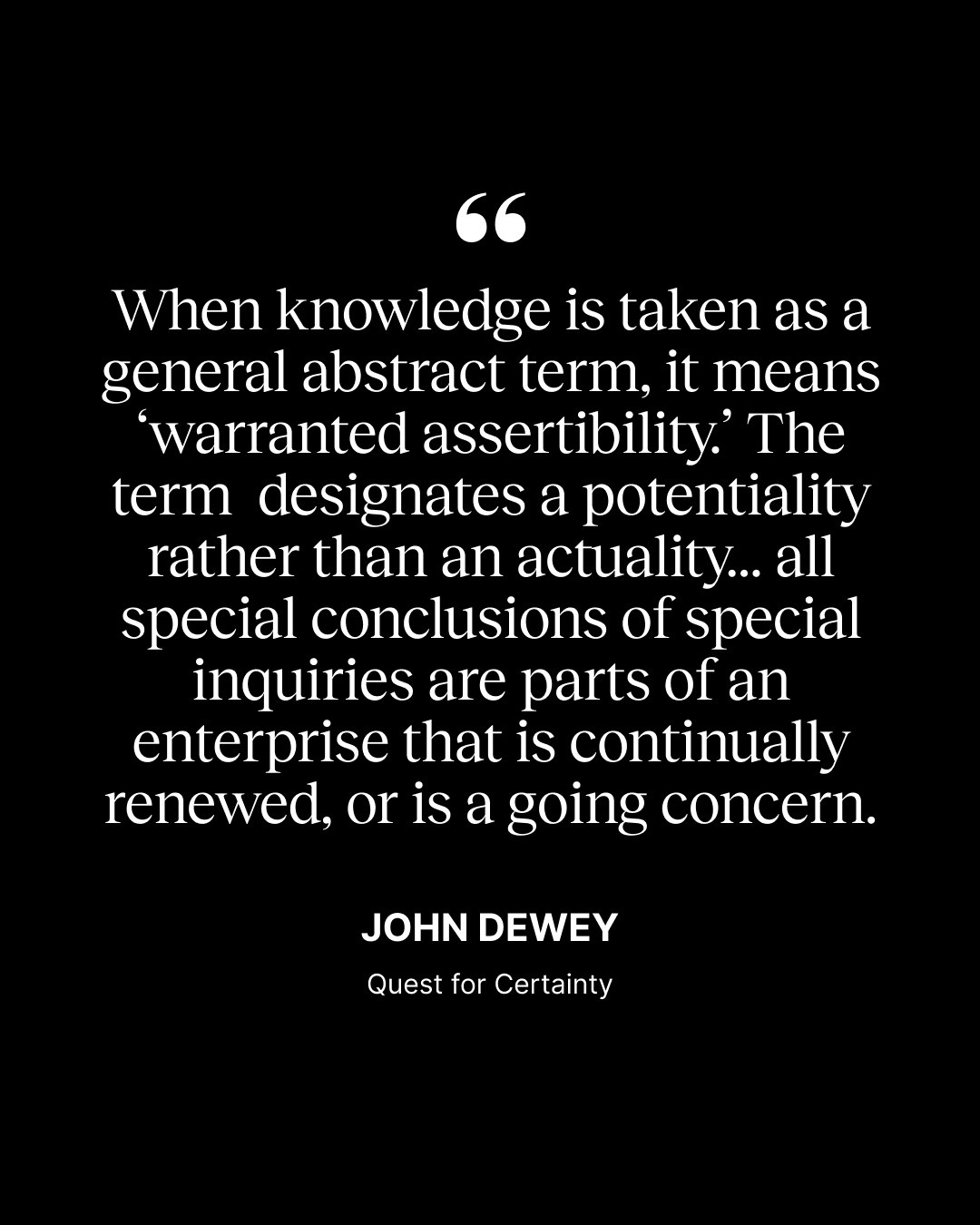
Finally, John Dewey was the most pragmatic of the pragmatists. He sneered at the intellectual parlor games philosophers played on the European continent. He didn’t have any time for the weird metaphysics of Hegel or the lofty pretensions of the Rationalists. For Dewey, we live tethered to the world, so let’s make sure our philosophy and ideas are always tethered to that world.
I tend to oscillate between Peirce’s and Dewey’s versions of pragmatism. I believe — and I suppose it’s nothing more than a belief — that we are getting closer to some kind of “best” truth, but we’re certainly not there yet. But I’m also a fan of Dewey’s idea of “warranted assertions.”
Dewey argued that we are warranted in believing things that are the result of “competent inquiry.” In other words, we should believe those things that come as a result of lots of good, hard thinking. Sometimes, this happens through private, hands-on experimentation, but more often, it’s a communal effort. It’s a group inquiry — the kind you get in breakout rooms, town hall meetings, and university seminars. It’s the collective thought process of many competent inquirers, be that scientific consensus, political tradition, or moral and social norms.
For Dewey, this competent inquiry is always subject to the needs of the times. It doesn’t correspond to some “actual” truth in the Woods of Pure Philosophy but rather presents a system or way of thinking that works. And this way of thinking isn’t fixed. It’s fallible and provisional. Sometimes, something is “warranted” based on the best available evidence right now. It is open to being revised, refined, or discarded if new evidence or a better framework comes along. It’s not a million miles away from what Thomas Kuhn would later call a paradigm (with paradigm shifts being possible).
Here are three examples:
Warranted: The Universe is about 13.8 billion years old. This is an answer that emerges from the cosmic microwave background, the ages of the oldest stars, and the observed rate of expansion. I’ll leave it to Ethan Siegel, Big Think’s resident astrophysics expert, to explain the details. But it’s also provisional. It’s the best-supported system we have for making sense of the evidence we have.
Unwarranted: Space and time are absolute. This belief was a foundational pillar of Newton’s system, and it was warranted for two centuries by Dewey’s standards — it predicted, it worked, it put ships across oceans. Then relativity came along to show that it was still perfectly serviceable at certain speeds but wasn’t an accurate universal answer.
On the cusp: The world is entirely material and mechanistic. I’ll leave this controversial one right to the end. For hundreds of years, science has told us that the Universe is matter in motion and nothing more — a very large machine whose every part, mind included, is explicable by the laws governing the parts. But recent research into the quantum world, dark matter and dark energy, and the inexplicable but unignorable fact of consciousness at least challenges this worldview. Is it warranted to carry on believing something that so inadequately explains all the newest evidence?
So, what beliefs do you think are unwarranted? What beliefs are on the cusp?
NEW RELEASE

Watch my Big Think Interview about The 3 elements of stupidity.
IN A QUOTE

Jonny is the creator of the Mini Philosophy social network. He’s an internationally bestselling author of three books and the resident philosopher at Big Think. He's known all over the world for making philosophy accessible, relatable, and fun.
More Big Think content:
Big Think | Big Think Business | Starts With A Bang | Big Think Books
I look at the world as a biologist in terms of evolution: everything is adapting to everything else constantly rearranging. So what is true today is less true tomorrow, because the world is not the same.
A question I keep returning to reading this: does a "real" answer exist, or is every answer inherently indexed to whoever recognizes it? Every community — every person — holds their own warranted assertions. What we call truth seems to be whatever a sufficient number of us grant recognition to — a self-referential process where what a community affirms as truth becomes truth by virtue of that affirmation, which then produces more affirmation. Truth is what enough of us keep calling truth.
Dewey names the inquiry; it takes another step to name the ratification. If truth requires an audience to be truth, then Peirce's convergence, James's cash value, and Dewey's warrant all rest on a fourth term — recognition — that pragmatism itself hasn't quite worked out. The scroll and the map may share a hidden third: an audience.