


Hello everybody,
This week we’re looking at “wasting time.”
You can find the companion article here: How gamification can ruin your life
Paid members can hear my audio narration at the end of the newsletter.
I wouldn’t say I’m contrary. But I do like a debate.
Two weeks ago, I was on stage debating whether we should view life as a game. As with all philosophical discussions, so much hinges on what we mean by the terms we use. And, as we explore in Big Think’s latest special issue, “a game” is not an easy thing to define.
Some games are fun. Some games have fixed rules. Some games involve two or more people. Some games are target-oriented. We can list any number of important or common elements, but no game will be all of these things. And there'll inevitably be at least one exception to the rule.
During the debate, I argued, “Yes, we should view life as a game.” I said that recognizing and following rules for some beneficial outcome was what life was all about. And the speaker on my left said, “I don’t think we should be wasting time playing games.”
Now, I’m a gamer. I’ve played computer and board games since I could hold a console and follow a rule. But even if I weren’t, I think there’s something to be examined in that term: “wasting time.”
And so, this week we’re looking at the shoulds and should nots of spending your time.
Go well,
Jonny

You’re a pig and I’m Socrates
The British philosopher John Stuart Mill once argued that there are “higher” and “lower” kinds of pleasure in life. Higher pleasures are those things enjoyed by a person of class and taste: Caravaggio, caviar, and cigars. Lower pleasures are those enjoyed by the animal: feasting, fighting, and fornicating. How do I know if a pleasure is higher or lower? Well, I have to consult a “competent judge” who will tell me.
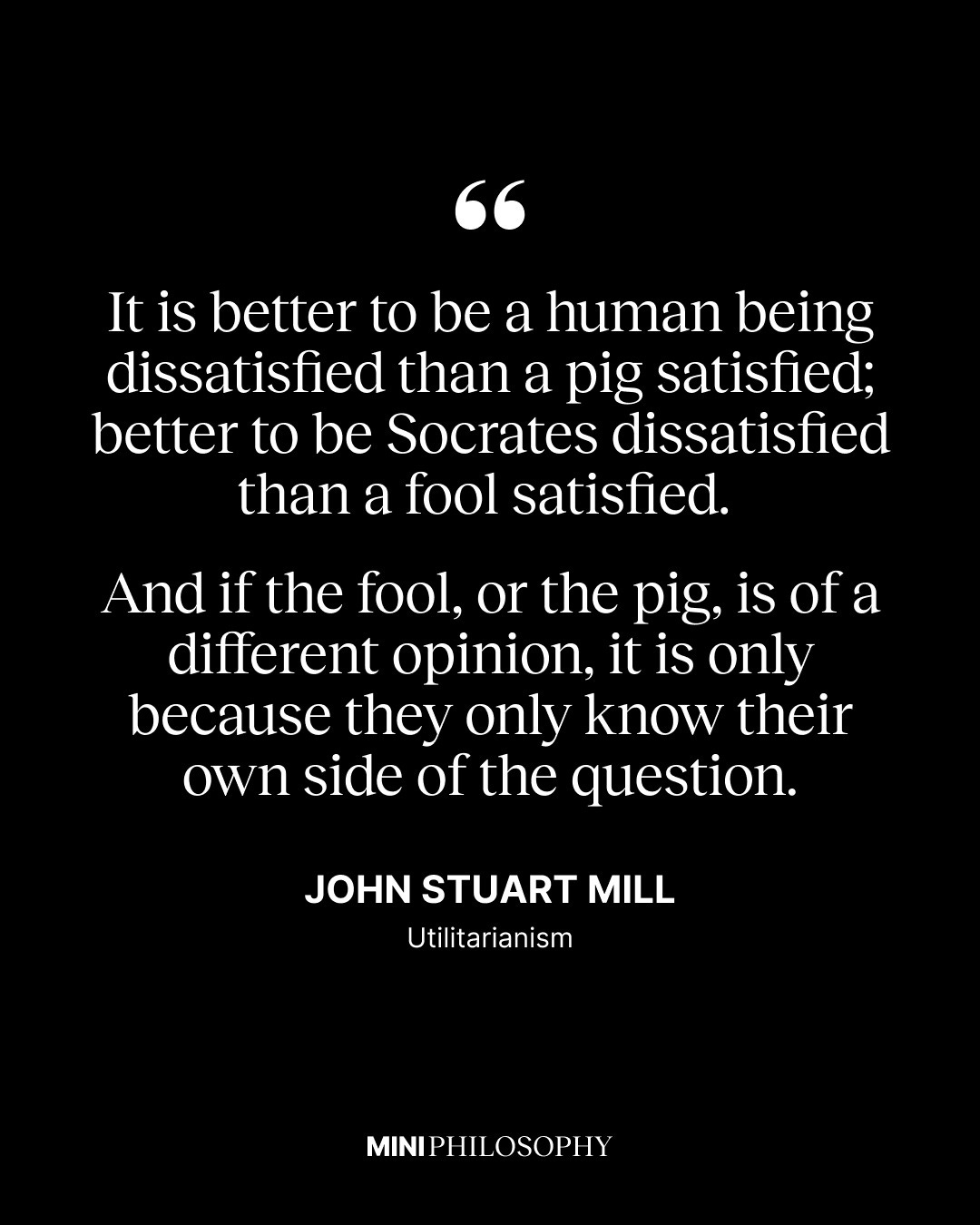
It doesn’t take a philosopher to point out the snobbery of Mill’s distinction. The idea that a person from certain wings of society has “more” or “better” pleasure than any other is pretty distasteful. It’s made worse when Mill writes, “It is better to be a human being dissatisfied than a pig satisfied; better to be Socrates dissatisfied than a fool satisfied.” The condescending imagery of a “fool” or a “pig” satisfied with their “lower” pleasures is hard to get on board with.
I’ve written about how often I used to lie about my tastes. I’d pretend to read certain literary novels, to drink certain kinds of drinks, and to listen to certain types of music. “My weekend? Oh yes, I was just reading David Foster Wallace with a red wine, listening to Handel.” In reality, it would be David Gemmell, with a generic lager, in silence. Heaven.
It might be that some people judge me for that, which is the point of this newsletter, really. Who gets to judge what a good or bad pleasure is? Who can say what’s “wasting time” and what’s “time well spent?” When Mill introduced his competent judges, he said they had to be those who had experienced a range of life’s many pleasures: wine and beer, Wallace and Gemmell, gaming and philosophizing. Then, after all that life experience, they can tell others what actually gives them pleasure.
There are two problems with this. The first is spectacularly obvious: We are all different. We have different taste buds, bodies, and brains. We experience the world and pleasure differently. Second, it’s incredibly difficult to extract “pure pleasure” from “mimetic pleasure.” Mimetic pleasure relates to René Girard’s idea of mimetic desires, where he says we kind of inherit or borrow “what I want” from other people. If everyone wants that colour car, so do I. If everyone lives in that kind of house, so will I. If everyone gets married and has kids, I might as well. So too with pleasure. We are taught what is and what is not a “good” kind of pleasure. We spend our time not necessarily as we want but as we think people want us to want.
Growing up, my dad and I used to play World of Warcraft a lot. I was a maxxed-out elven hunter with a cool exotic mount, and my dad played as an easily killable fire mage. The fun we had. When I last saw him, I (somewhat jokingly) suggested we should play again.
“Oh,” he replied, “that would be so good! But then I really ought to practice my guitar and play golf.”
As you can tell, my dad is retired. Few jobs pay you to fumble around a blues guitar and hit a tiny ball around a park. But the point is that my dad often stresses about what fun to have. Even if playing World of Warcraft would be incredible fun, it feels like “wasted time” because that is what the judgmental voices of the “competent judges” tell us.
So what do you think? Do you think we can form any objective account of “wasting time”? Or is that a question each of us has to answer on our own?
IN A QUOTE
MEMBERS ONLY
Paid members can hear my audio narration below: