

The missing vertical thread
Why the lack of intergenerational friendships makes us worse off.


Hello everybody,
This week, we’re looking at intergenerational friendships with Dr. Kerry Burnight.
You can find the companion article here: The philosophy of indoctrination and how to fix it.
Paid members can hear my full interview with Dr. Kerry Burnight at the end of the newsletter.
I used to work with a man named Dave.
Dave was an old-school Cockney geezer. He would slick his hair back like Elvis and had the voice of a man who liked to smoke.
When I first moved into an office with Dave, it was great. When you grow up phoneless in the East End of London with a local pub two doors down, you learn how to spin a yarn. And Dave could turn a stale two-minute anecdote into an hour-long drama worthy of NPR.
But what I enjoyed in entertainment, I paid for in service. Because Dave was an old-school Cockney Luddite, as well.
“Jonny mate,” he’d say, “Can you tell me how to log in to this new intranet?”
I knew all of Dave’s passwords.
“JT! JT! Why can’t I just do it this way instead?”
I went to Dave’s funeral late last year, but — if I’m honest — we’d fallen out of contact long before that. Some friendships depend on a time and a place. But I miss him. I miss the way he’d swear far too loudly in polite company, how he’d always be up for a Friday drink, and how his passwords were his grandkids’ names. But I also miss knowing Daves. I miss having friends — real friends — who weren’t the same age and stage of life as me.
This week, we look at intergenerational friendships.
Go well,
Jonny

The missing vertical thread
In the 1960s, the British philosopher and polymath Michael Polanyi argued that there are two kinds of knowledge: tacit and explicit. Explicit knowledge is all the stuff that you can talk about, write about, and explain. I can tell you about the water cycle, you can tell me how to make scrambled eggs, and Dave could tell me about growing up in Hackney. Tacit knowledge is what you know but can’t explain. Why do you hate jazz? How can you tell if someone’s looking shifty? Can you tell me how to ride a bike?
In this week’s Mini Philosophy interview, I spoke with the gerontologist Dr. Kerry Burnight about her new book Joyful. During our conversation, we talked about how important it is for older people to have younger friends and vice versa. Older generations benefit from the enthusiasm and “not-going-to-die-soon” vitality of youth, and the younger generations benefit from the wisdom of older people.
But what does that actually mean? It can be both patronizing and clichéd to say, “The older generation has so much to teach us.” It’s a cliché because everyone says it. And it’s patronizing because “so much to teach us” often means some whippersnapper nodding their head aggressively and making “hmm” noises while granddad tells us all a story we’ve all heard before. That is not what Burnight means, and it’s not what teaching means.
The wisdom you get from intergenerational relationships is not explicit knowledge. With the greatest respect possible, unless my friend is a recently retired professor from a top university, Wikipedia, or even AI could probably teach me the topic better. What you learn from older generations is what the ancient Greeks called phronesis — or practical wisdom.
Phronesis, like any skill or ability, is something you get better at the more you use it. And while you can theorize your way to a degree of practical wisdom, by and large, you can’t skip the hard part. You have to have been in a sticky situation or two to know how to get out. You have to know different kinds of people to know how to deal with the next one. You need to know hardship, suffering, and loss to know how and why you must carry on.
The great thing about phronesis — and why it’s often seen as a tacit kind of knowledge — is that it’s fundamentally adaptive. Phronesis will change to the context you provide it. It speaks to the person in the room and responds to the myriad factors that make this situation, right now, a difficult one.
When we are growing up, we often see our parents as role models. Not necessarily in the moral sense — our parents can do all sorts of wild and immoral things — but in the sense that they model how we should interact with the world. Parents define what’s normal. But then, at a certain age, our parents are shuffled from center stage to somewhere in the wings. They go from putting you to bed every night to buying you socks at Christmas. For the rest of our lives, most of our day-to-day existence is surrounded by people who are the same as you. And everything is the same. In my 20s, we all talked about relationships, work, and the gossip of young adults. In my early 30s, it was all about weddings, houses, and cars. These days it’s about pensions, careers, and back pain. We’re all going through the same problems, and we’re all fumbling and guessing our way forward.
When I shared a room with Dave, I absorbed his phronetic knowledge like a philosophical sponge. I never took notes or noticed what was happening, but it all went in somewhere. I heard how he opened a conversation with the boss — friendly, funny, but firm. I saw how he moved his hands in just the right moments as he was telling a tale. I listened to his laugh. His warm, loud, contagious laugh.
Dave role-modelled life with all his years of tacit knowledge, and I absorbed it all through tacit learning. I grew when I was around Dave in a way that I never did around my peers. It’s wrong to call Dave “avuncular” or “a father figure” — he was a friend, and it’s important we appreciate that category.
These days, all my friends are within the same ten-year window as me. I work at home, and I write. I live with my family. Occasionally, I’ll interview a tenured professor or an aging author — but they’re not my friends. We’ve set up society to run in horizontal strips: childhood, studenthood, young adulthood, middle age, retirement. Each division does its best to deal with the world as it can, but is forced to reinvent its solutions again and again. We have lost the vertical thread — the old sitting with the young, not to tell stories or to teach some explicit theory, but simply to live alongside them. And in doing so, we have lost one of the oldest and most powerful forms of growing up.
IN YOUR OPINION
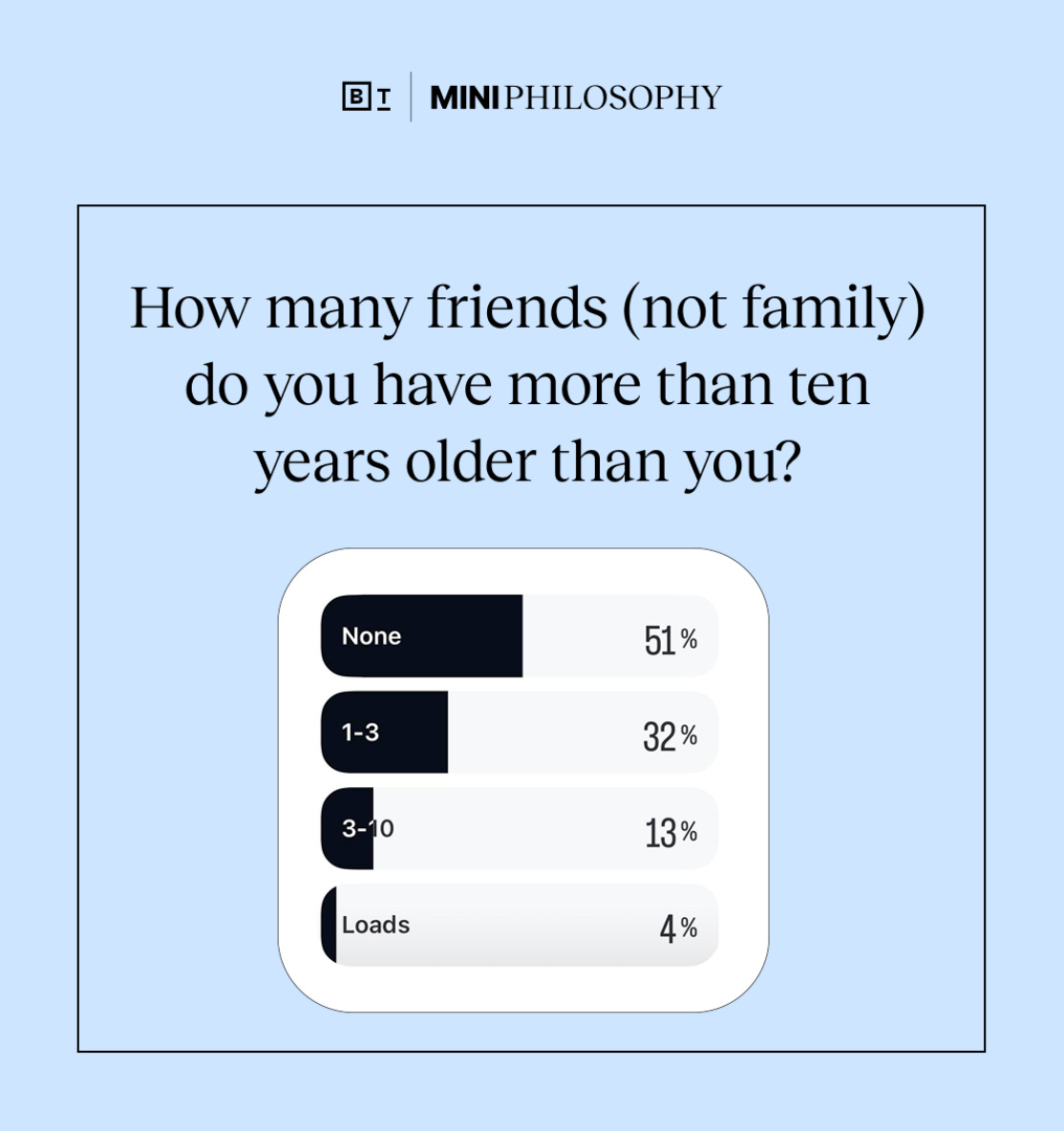
Roughly half of about 5,000 respondents on the Mini Philosophy Instagram page said they have no friends more than ten years older than them. Why do you think this is? Message or comment below.
Next week, we’re exploring reading books and so I’m asking:
What book have you read the most times and why?
Send me your thoughts via email or comment below.
MINI READING LIST
Check out Big Think Books for all the bookish stuff you can want.
MEMBERS ONLY
Watch my interview with Dr. Kerry Burnight here: