


Hello everybody,
This week we’re looking at alter egos.
Paid members can hear my audio narration at the end of the newsletter.
I met Ben at university.
He lived in the corridor just above mine, and we got chatting in those golden days when you could just go up to anyone and start a friendship.
“Hey mate, what’s your name? What are you here to study? Cool, cool. Fancy a drink?”
Ben was an archetype. He was an artsy, romantic sort who wore loose knitwear and an Alibaba scarf he’d bought from a souk in Morocco. Authentically Bedouin, handmade.
I’m not exactly unpretentious myself, and so Ben and I became friends from the start. We talked about books and philosophy. We played guitar in his room. Our friendship groups never entirely overlapped, but we always got on. But he never invited me to see him during the holidays.
There’s nothing wrong with this. To be honest, I never really thought about it. We all have our lives, and we weren’t best mates. But then, just before Christmas in our second year, he told me why.
“I’m a totally different person,” he said. “At school, I never talked about this stuff. I was just a different Ben. I don’t really have any good mates back home.”
When Ben got to university, he decided to become Hipster Ben. He built an entire alter ego for himself and slipped deep inside. Was there a “real Ben” somewhere? Perhaps, but I don’t really care. He seemed happy and at peace. He liked the face he wore.
This week we look at the power in using alter egos — a power that Salvador Dalí knew well.
Go well,
Jonny
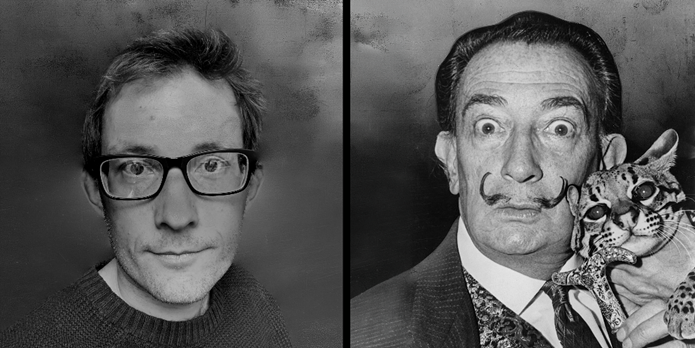
The Dalí trick
Dalí is one of the most popular artists in the world. As a young boy, I remember going to a museum on a school trip and, with my crisp £5 note, buying one of his prints. It stayed in my room for my entire childhood. I’m sure I am not alone in having Dalí’s aesthetic punctuating my past. His leggy elephants and warped clocks are artistic memes. They’re so popular that the really artsy people sneer at them. Ben would hate Dalí.
Of course, Dalí was a talented Surrealist. But one reason he was so successful was that he understood the power of a good alter ego. Dalí would refer to himself in the third person. “Dalí says,” “Dalí thinks,” “Dali never,” and so on.
It’s a common affectation of the melodramatic, but Dalí would often do his best work behind the mask of this personality. I am sure he would wake up, read the news of the world, sip a coffee, and work through his day with the boring routine of just another human. But Dalí? Well, Dalí was a genius. He had a quirky moustache and pulled funny faces. He was overcome by muses and had to be left to his art.
In 1949, after Dalí had earned several million, not least because of a lucrative collaboration with Walt Disney, a somewhat snooty rival and the founder of Surrealism, André Breton, gave Dalí a new nickname: Avida Dollars. It was a play on “avid for dollars” in French and was supposed to mock Dalí for selling out. How could this artistic genius deign to earn so much and goose-step along to the capitalist overlords?
Dalí laughed. As Nietzsche had said a century before, true power comes when you can shrug off an insult and wink at your insulters. In fact, Dalí went a step further: He adopted the name. He said the name had a “certain magical value,” and that ever since Breton had given it to him, “the rain of dollars has not stopped falling.”
Under the persona of Avida Dollars, Dalí embraced his inner entrepreneur. He made more and more money, became more and more successful, and never looked back at Breton and the other surrealists.
We often talk about the need to “be authentic.” There’s an idea, inherited from religion, that says we have some innate soul that defines who we are. This essence is who we “actually” are. It’s the real me. Ben, with his Bedouin scarf, is just pretending. Dalí as Dollars is an act.
I’m sure that many of us can relate to the feeling of inauthenticity. We all resent having to talk and behave a certain way. When I was a teacher, the flashy suits and double Windsor knots never really felt right on me. But this doesn’t necessarily mean there is a core me.
The sociologist Erving Goffman’s dramaturgical theory argues that all of our public-facing lives are acts. The moment someone lays eyes on you, you become a role. We can no more avoid wearing a role than we can avoid putting on clothes. Jean-Paul Sartre called this “the gaze.” It’s the moment you are transformed from being you on your own to being a person on display. The gaze can feel terrible — “hell is other people,” after all. Or it can feel liberating — being seen as good, kind, or brilliant feels great. It can even inspire us to be great.
What Ben and Dalí both realized is that the real power comes in choosing which person we put on display. If Goffman is right, we have to play a role. But the trick is to take control of what role that is.
Let’s say I create for myself an ego called “John the Resilient.” This person has the steely eyes of Clint Eastwood and loves running up steps in the snow. And so, if life throws me some hardship — even if it’s just a sniffle — I can adopt my John the Resilient skin. What would John do? He’d shrug it off, never complain, and go about his life.
There’s a fun study from 2017 where researchers put a selection of four and six-year-olds in two groups and asked both to do the same task. One group was just told to do it, and the other group was told to do it as a persona: Dora the Explorer, Bob the Builder, or Batman. The children pretending to be someone else persisted the longest. The researchers called it the “Batman Effect.”
So, the question isn’t, “Who am I, really?” That question has no good answer and tends to make people miserable. The better question is the one Ben and Dalí both stumbled into: Who do I want to be in the room? Put that person on, wear the mask, and let yourself play along.
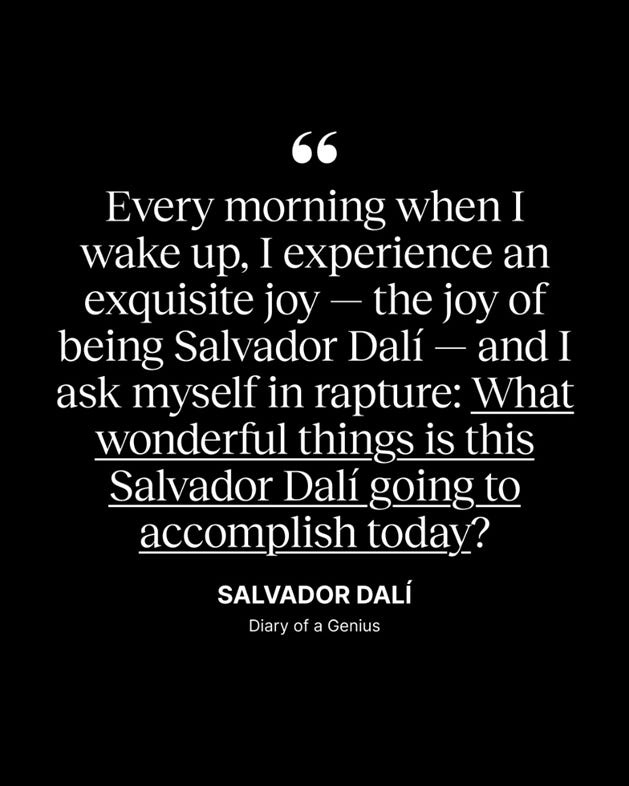
IN A QUOTE
MEMBERS ONLY
Paid members can hear my audio narration below: