


Hello everybody,
This week we’re looking at pseudo-profound BS.
Paid members can hear my audio narration at the end of the newsletter.
My editor is very good at mimicking me.
Given that he’s had to edit at least two of my pieces every week for the last three years, it’s hardly surprising. He knows what sounds like Jonny. He knows the beat and tone of my voice. He knows that I like to have three sentences in a row starting with the same words. And so, Steve will often message me in the style of Mini Philosophy, or in the voices of other writers we know. It’s always good-natured and always very funny.
Steve’s workplace banter has pushed me into a spiral of self-obsessed, navel-gazing anxiety. Am I really that predictable? Am I so easily mocked? Well, no, Steve. I’m not. Because I reckon that there are actually two versions of my voice. There is the one you get most often in this newsletter — chatty, irreverent, and flecked with philosophical tidbits. It’s the one that comes most naturally to me because that’s pretty much how I am and how I speak.
But, very occasionally, I’ll put on a beret, swish a pashmina shawl around my neck, and swagger a little. I’ll pull out the thesaurus and will lace my paragraphs with polysyllabic floridity. I’ll use long Gilles Deleuze quotes and pretend to understand Julia Kristeva.
Possessed by these muses of purple and pretentious prose, I’ll saunter through the corridors of half-meaning. I’ll dance, wisplike, through allegory and myth. I’ll muddle my metaphors like a Shakespearean mixologist with a wilful disdain for clarity.
This week, we’re looking at my Mr. Hyde voice. We’re going to look at what the researcher Gordon Pennycook calls “pseudo-profound BS”.
Go well, my comrades in consciousness,
Jonny

Pretend. It’s never too late.
Years before generative AI as we know it, I fell in love with a website called InspiroBot. Back then, we called these things “web tools.” But a “web tool” doesn’t get $340 million in venture capital backing, so let’s just call it “AI” like everyone else does.
The idea behind InspiroBot is simple: You press a button, and it whirrs together a series of deep-sounding words into a plausible grammatical structure, giving you something that looks profound. It then plasters that quotation onto an artsy-looking background and, hey presto, motivational content.
For example, here are two favorites from just today:

Now, given that I’ve framed these quotations in a newsletter all about “pseudo-profound BS,” I’m sure you can laugh along with me. Both of these quotations are utter nonsense.
And yet, even with that framing, we still want them to work. They seem plausible. They use words we know and a structure we recognize. “Never too late” often pops up in deep-sounding passages, so that must be good, right? “Growing old” and “work of art” are two squares on a “deep BS” bingo card. We’ve become so trained to read and nod along to things like this that, when we’re presented with literally random sentence structures carrying no intention or meaning, we assume the fault lies with us. We strain to find the deep and actionable truth behind them.
“You’re right. I should pretend it’s never too late. I should live as if I’m immortal and embrace the moment. I need to jump off a boat into the Mediterranean. It’s time to live, laugh, and love!”
The researcher Gordon Pennycook won the 2016 Ig Nobel Prize for showing that, in neutral settings — that is, where I haven’t framed it like this — a lot of people really can’t tell the difference between genuine philosophy and pseudo-profound BS. And, of course, as somebody who spends a lot of time exploring supposedly profound non-BS, that is a bit of a worry.
Pennycook argued that there are two reasons for this. The first is structural: If you read a well-formed, or even beautiful, sentence, you want to assume that the author has given as much thought to the meaning as to the poetry. The second has to do with the words themselves: If you come across deep and philosophical words, you want the sentence to work. And if you can’t understand it at first, you blame yourself rather than the incomprehensible word salad in front of you. Confusion gets relabelled as depth, and the author gets rebranded as some misunderstood sage.
But as Nietzsche once put it, we should beware those who muddy the water to make it appear deep. There is an entire class of people in marketing, management, politics, the wellness industry, and philosophy who think that stringing together a series of profound words makes them a genius.
Richard Feynman used to say that if you can’t explain something in simple language, odds are you don’t understand it yourself. If someone has to hide their groundbreaking hot takes behind massive words and breathless sentences, then the chances are those takes aren’t as hot — or as clear — as they think. It’s easy to vomit up some plausibly pretentious prose and then blame other people for not understanding you. It’s far, far harder to teach someone or explain yourself properly. I’ve suspected for a long time that the real geniuses are the people getting top-voted on the Explain Like I’m Five subreddit.
Words are only as deep as they can be understood. And if somebody hides their ideas behind pseudo-profound BS, perhaps those ideas weren’t as clear as they thought to begin with. You’re better off having a laugh with InspiroBot.
IN A QUOTE
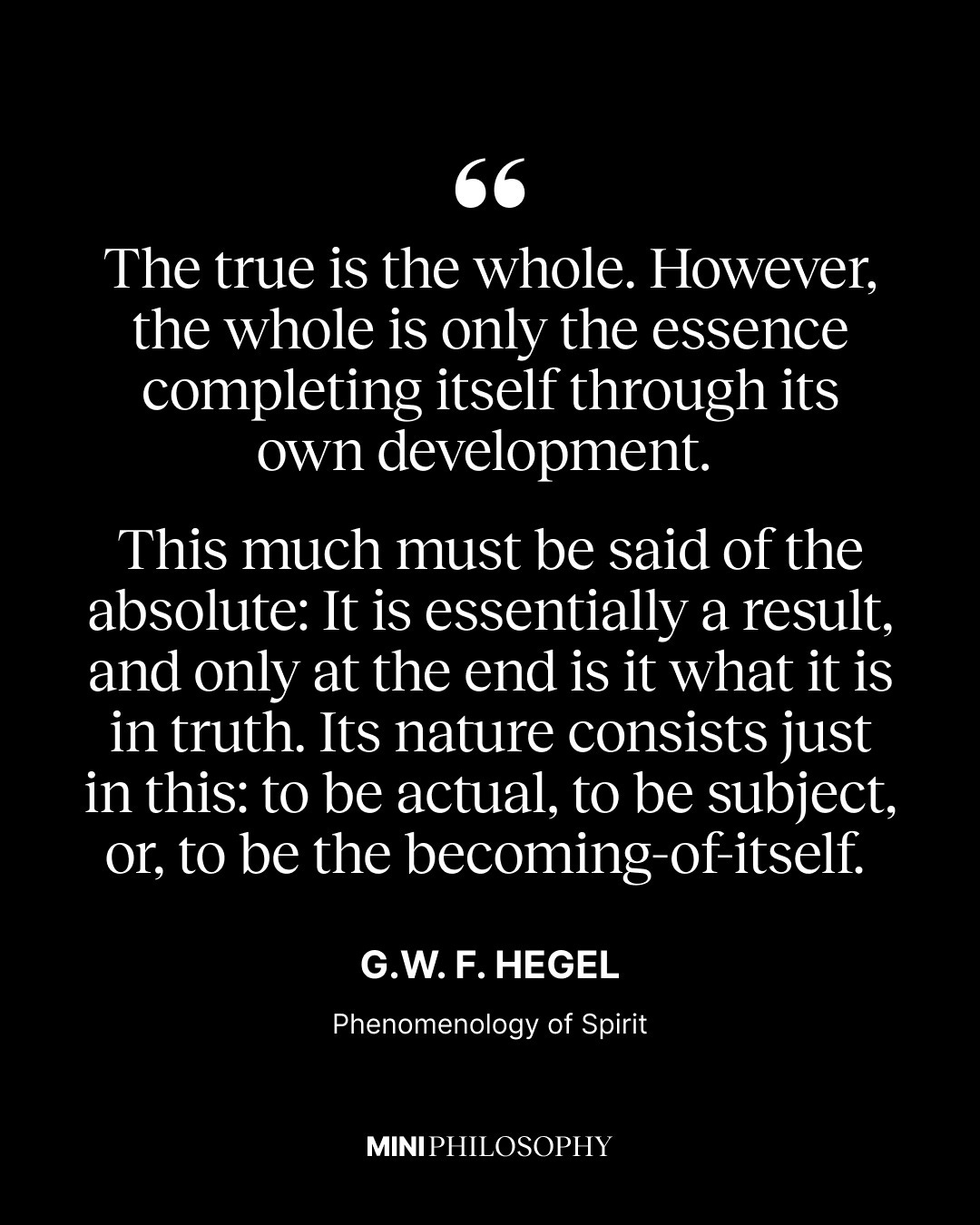
Classic Hegel:
MEMBERS ONLY
Paid members can hear my audio narration below: